What Guides My Work
A few ideas that shape how I understand people, healing, change, and what becomes possible in the right conditions.
My work is grounded in a simple but deeply held belief:
There is more wholeness in us than our difficulties may lead us to believe.
Life can fragment our experience. Trauma, loss, relationships, culture, oppression, discrimination, migration, chronic stress, and other forms of adversity can shape the ways we protect ourselves and move through the world.
But fragmentation is not the same as being fundamentally broken.
I believe that the capacity to adapt is part of why we are still here.
And I believe that, under the right conditions, people have meaningful capacities for healing, integration, and change.
Wholeness, Adaptation, and the Capacity to Heal
Many of the ways we respond to life make sense in context.
We may learn to anticipate other people's needs, stay composed, disconnect from our bodies, overthink, avoid conflict, become highly self-sufficient, or stay constantly alert to what is happening around us.
These responses can become sources of suffering, especially when they continue long after the circumstances that shaped them have changed. But I don't see them as evidence of personal failure.
I view them as intelligent adaptations.
This does not mean that every adaptation needs to be kept. Sometimes healing involves repairing what has been hurt enough that an old way of protecting ourselves is no longer necessary in the same way. Sometimes it means developing new choices. Sometimes it means allowing something to soften, change, or be released.
The goal is not to fight the parts of ourselves that learned how to survive.
It is to create conditions in which something different can become possible.
And underneath all of this is a belief I hold close:
Wholeness is not something we attain once we are healed. It is something that remains, even when our experience has become fragmented.
Creating the Conditions for Healing
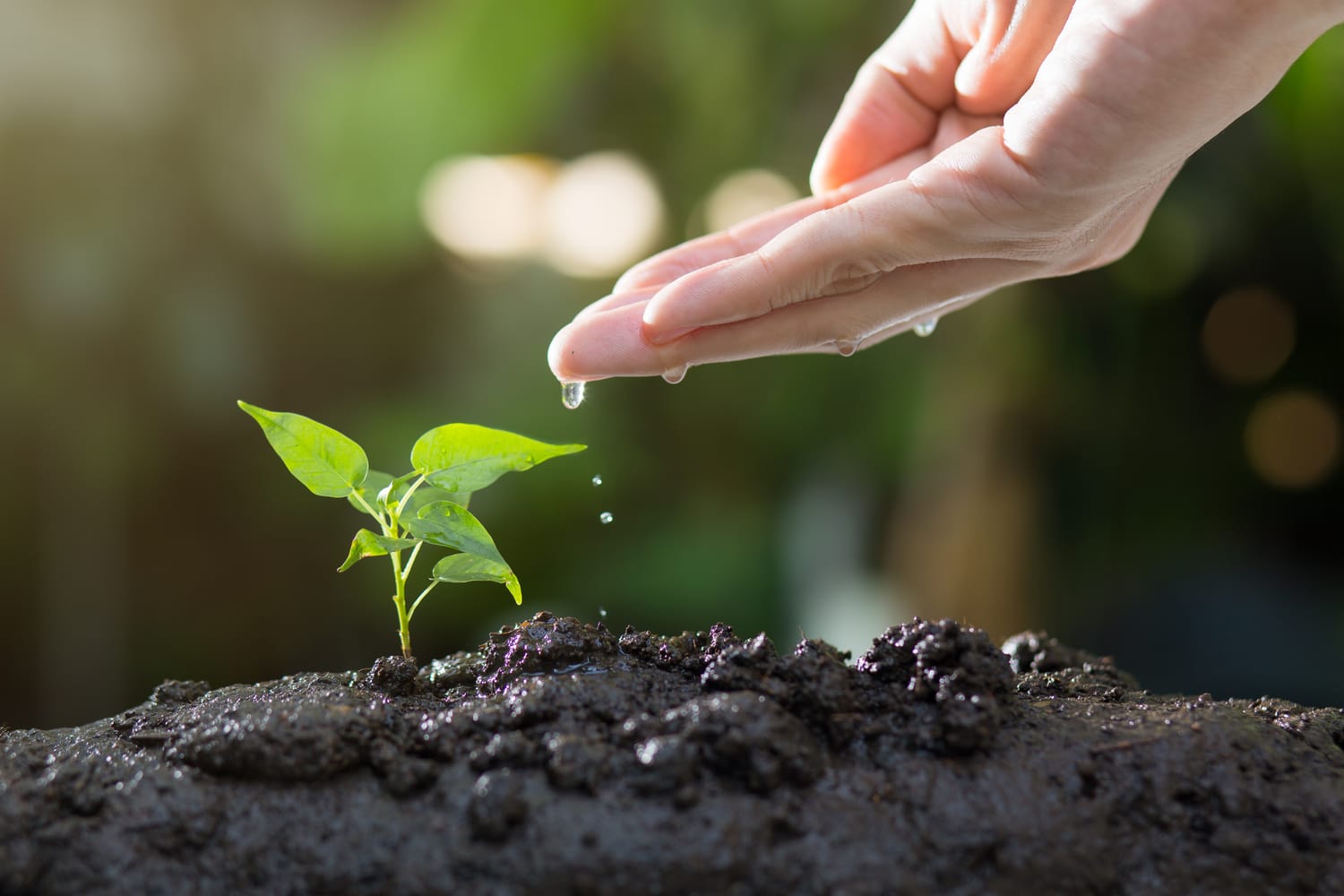
As a Brainspotting practitioner, I’m deeply influenced by the idea that our brain, body, and nervous system structures have an inherent capacity for self-healing, and that this capacity can be supported by the conditions around it.
This shapes how I understand my role.
I don't see myself as someone who needs to determine the right answer for another person or make healing happen from the outside.
My role is more relational and collaborative: to help create conditions in which a person's own knowing, capacity, and healing processes have more room to emerge.
That requires attention to things like a sense of safety, attunement, trust, embodiment, curiosity, and choice.
I am not the expert on another person's inner world. I bring training, experience, curiosity, and ways of working. The person in front of me brings knowledge of their own life that I cannot have.
The work happens in relationship.
Holding What We Cannot Know
I also hold a belief that our lives are connected to something larger than ourselves.
I don't mean this as a particular religious framework, or as something I expect another person to believe. For me, it is more an openness to mystery: to the possibility that there are dimensions of human experience that we cannot fully explain, measure, or understand.
That might be experienced through spirituality, a sense of connection with nature, relationship with ancestors, or simply an awareness that we are part of something larger than our own story.
I don't experience this belief as separate from my trust in science, neurobiology, clinical knowledge, or the careful use of creative practices. I can value what we know while remaining open to what we don't.
This openness is part of how I understand my role in the work.

I bring my training, experience, clinical judgment, creativity, and presence. I also listen for the quieter forms of knowing that can emerge through intuition, relationship, the body, or the unfolding of a moment. Sometimes I have a sense that something is worth following before I can fully explain why. I don't assume that makes my intuition infallible, or that I have special access to some higher truth. I simply try to stay open to what may be emerging and hold it with discernment, meeting these moments with curiosity rather than certainty.
I am responsible for how I show up in the work, but I am not the author of another person's path. There is something deeply humbling about remembering that the unfolding of another person's life is larger than anything I could orchestrate.
Arinomama AT E.A.S.E.™
Meeting yourself as you are.
Building a relationship with yourself you can trust.
Making more room for who you are and who you might become.
At the heart of my work is arinomama, a Japanese concept that can be translated as “as you are.”
For me, arinomama is not about resignation or simply acquiescing to things as they are. It is an invitation to meet yourself more honestly and make room for the whole of your experience, including what is complicated, uncertain, tender, contradictory, unfinished, or still becoming.
Arinomama AT E.A.S.E.™ is the framework I developed as a way of making this orientation more tangible across my work.
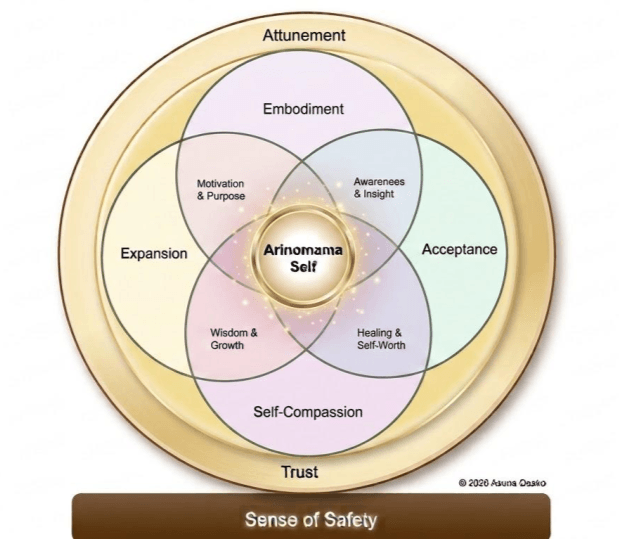
At its center are four interconnected qualities:
Embodiment
Coming into greater relationship with the body and the information it carries. Noticing sensation, movement, impulses, energy, and the ways experience and knowing lives beyond words.
Acceptance
Making room for what is here without requiring it to be different before we can relate to it. This includes arugamama, a Japanese concept that speaks to the willingness to meet reality as it is rather than continually fighting what is already present.
Self-Compassion
Cultivating a kinder, supportive, and more curious relationship with ourselves, particularly in places where we feel vulnerable, uncertain, ashamed, or stuck. And especially toward the parts of us that learned to protect, adapt, or survive in difficult circumstances.
Expansion
Creating space for greater possibility. As we become more able to stay connected to ourselves, we may discover new choices, perspectives, relationships, and ways of being that were previously harder to access.
These four qualities are not steps to move through or skills to master. They overlap and continually shape one another. Embodiment can deepen acceptance. Self-compassion can make expansion possible. Expansion can change how we experience our bodies and what we believe is possible. The work happens in the spaces between them, too.
Surrounding the four pillars are Attunement and Trust.
Attunement is the practice of noticing and tuning into what is happening, within ourselves and around us, with enough presence and curiosity to respond rather than simply react. Trust grows through that ongoing relationship with ourselves: learning to listen, notice, discern, and recognize that our experience has information worth attending to.
Attunement also includes the relational experience of being listened to, understood, respected, and met without having to perform or show up a certain way. Trust develops through that ongoing process of being met.
To me, trust is also about trusting in our capacity for healing, growth, and change that often far surpass what we may initially believe possible.
And the whole framework sits atop of a sense of safety.
By safety, I don't mean simply feeling calm or convincing yourself that everything is safe, especially when unsafety and danger are legitimate realities in our world.
A sense of safety does not mean that everything around us is safe, comfortable, or predictable. It is the felt sense that there is enough safety, support, and space to remain in relationship with ourselves as we encounter what is here. Without some foundation of safety, it can be difficult to slow down enough to attune, to trust what we notice, or to explore new possibilities.
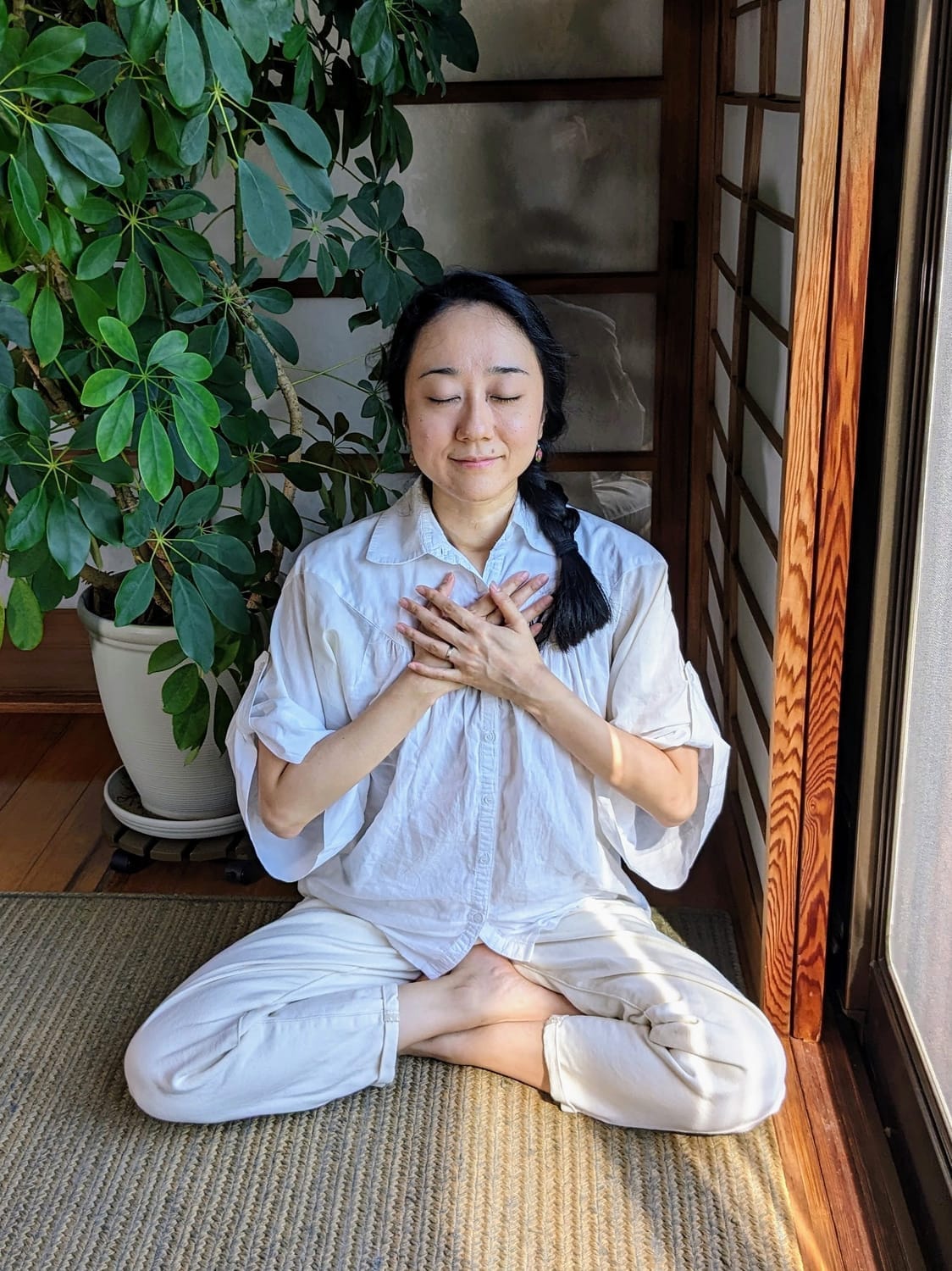
Developing a sense of safety is foundational, particularly when someone has experienced trauma or chronic stress. Part of the work of developing that sense can be learning to notice the cues of safety that are actually present in the here and now. (for example, you reading this page right now is only possible because there is at least enough safety for you to be doing so!)
When we have more capacity to orient to what is safe enough in the present, we may be better able to notice what is happening inside us without being completely overtaken by it. We can develop more access to the body's signals, more capacity for regulation, and more choice in how we respond to trauma-based or survival-based reactions.
Over time, a greater capacity to notice and orient to safety can create more room for curiosity, connection, flexibility, and change.
This framework informs both my clinical work through Gentle Depth Therapy and the educational, creative, and experiential work I offer through Easeful Presence Center. The expression may look different in each space, but the underlying orientation remains: meeting yourself as you are, building a relationship with yourself you can trust, and making more room for who you are and who you might become.
Staying Connected to Yourself
One question sits underneath much of my work: What helps people remain connected to themselves in emotionally meaningful moments?
Not perfectly.
Not without being affected.
Not by becoming endlessly regulated or detached from difficult feelings.
But with enough connection to notice what is happening, enough safety to stay present, and enough choice to respond rather than simply repeat what has always happened.
Sometimes that connection is not immediately obvious.
Sometimes that connection is felt in relationship, in nature, or in moments when something larger seems to touch our experience.
Sometimes it looks like feeling something in the body for the first time.
Sometimes it is recognizing a familiar pattern with new eyes.
Sometimes it is discovering that a part of you that has been carrying something for years does not have to carry it in quite the same way anymore.
And sometimes it is simply being able to stay present with an experience that once felt impossible to bear.
Looking Beyond the Individual
People do not exist apart from their environments.
My social work training and personal history continues to shape how I understand all of this.
People do not exist apart from their environments. Our experiences and struggles do not exist in a vacuum.
Our relationships, families, cultures, communities, workplaces, institutions, histories, and social conditions all shape what becomes possible for us.
Sometimes what looks like an individual problem makes more sense when we widen the lens.
That doesn't mean individual agency is irrelevant. It means agency exists within context.
I want my work to hold both: the deeply personal experience of being a person in a body, and the larger worlds that have helped shape that experience.
An Orientation, Not a Formula
These ideas are not a formula for how healing has to happen.
People are different. Contexts are different. What supports one person may not support another.
My hope is not to lead someone toward a predetermined version of wellness or tell them who they should become.
It is to create enough space for them to encounter themselves more fully, understand their adaptations with compassion, notice what is possible in the present, and develop greater freedom in how they move through their lives.
Explore My Work
Learn more about the different ways I work with individuals, groups, and communities.